
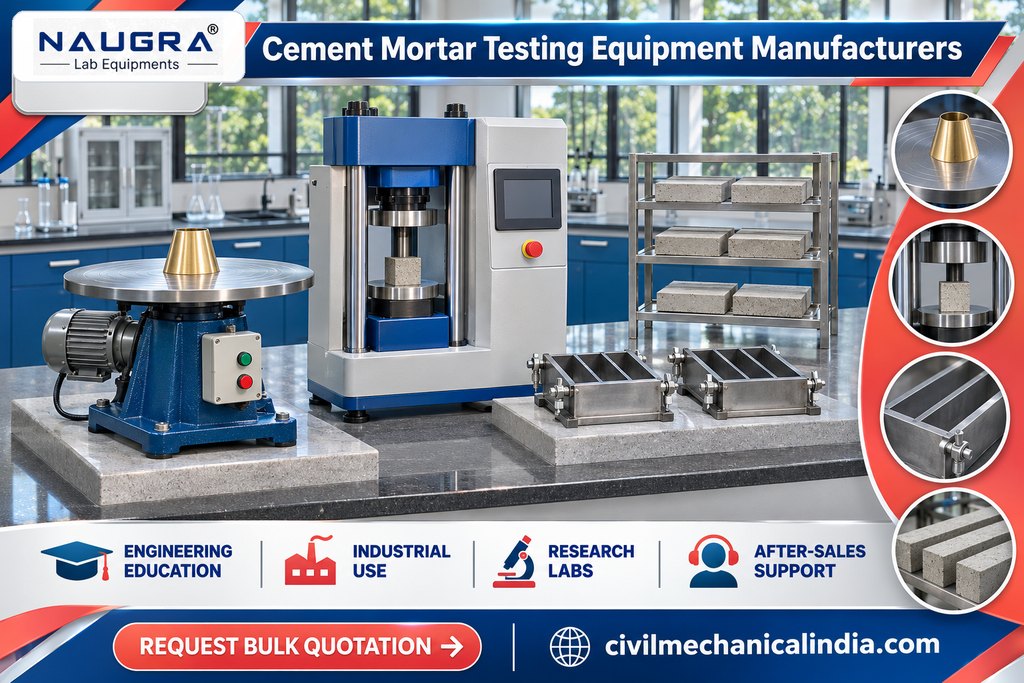
Our cement mortar testing equipment is designed for cement plants, dry-mix mortar producers, tile adhesive manufacturers and standards laboratories. We manufacture it in India. Below are the main machines with model codes for buyers in Africa and South America who are preparing a tender.
Our cement mortar testing equipment range
| Product | Model code | Use |
|---|---|---|
| Automatic Compressive Strength Machine for Cement Mortar Cubes | CMI-IND-0032 | Compressive strength of mortar cubes, automatic loading |
| Flexural Strength Machine for Mortar Prisms 10 kN | CMI-IND-0034 | Flexural strength of mortar prisms, 10 kN |
| Automatic Vicat Apparatus with Digital Penetration Timer | CMI-IND-0033 | Setting time with digital penetration timing |
| Air Permeability Blaine Apparatus for Cement Fineness | CMI-IND-0031 | Cement fineness by air permeability |
| Mortar Flow Table with Motorised Drop Mechanism | CMI-IND-0036 | Flow of fresh mortar, motorised drop |
| Le Chatelier Soundness Test Set with Heating Bath | CMI-IND-0035 | Soundness with heating bath |
Ten products are shown on our Cement-Mortar Testing Equipment page. The 10 kN rating is taken from the product name.
Tests and applications
| Product | Key tests |
|---|---|
| Cement | Setting time, soundness, fineness, mortar strength |
| Masonry and plaster mortar | Flow, water retention, air content, strength |
| Tile adhesive and grout | Flow, shrinkage, flexural strength |
| Repair mortar | Compressive and flexural strength, length change |
Cement is judged by the strength of a standard mortar, so the mortar tests are the most important in any cement laboratory. Dry-mix producers add fresh-state tests, because their customers judge the product by how it spreads and holds water on the wall.
Factory-made mortars are a growing business. Each product has its own standard and declared performance, and each batch is tested before it is bagged.
What to specify in a tender
- The cement or mortar standard, as specimen size and loading rate depend on it.
- Automatic or manual loading for strength machines.
- The number of moulds and the curing method.
- Flow table type, since EN and ASTM tables differ.
- Accessories for water retention, air content and shrinkage tests.
Organising a mortar laboratory
Mortar testing follows a strict timetable. Specimens are cast, demoulded after a day, cured in water or a cabinet and tested at set ages, often 2, 7 and 28 days. That means the laboratory needs enough moulds for several days of casting, a curing tank or cabinet large enough for a month of specimens, and a clear labelling system.
Place the mixer, flow table and moulds together on a rigid bench. The strength machines stand nearby, with a balance and a timer. Keep the room at the temperature and humidity the standard prescribes, and log both. Results drift quickly when a laboratory is too warm, which is a common problem in hot countries.
For dry-mix plants, add a sample divider and sieves for checking sand grading, and an oven for moisture. Raw material control prevents most finished product failures.
Markets we supply in Africa and South America
Cement production and factory-made mortars are both expanding quickly in these regions.
| Country | Nominal mains supply | Usual port of entry | Note for buyers |
|---|---|---|---|
| Kenya | 240 V, 50 Hz | Mombasa | Several cement producers compete, and each runs a full control laboratory. |
| South Africa | 230 V, 50 Hz | Durban | Dry-mix mortars and tile adhesives are well established and tested to local standards. |
| Senegal | 230 V, 50 Hz | Dakar | Cement exporters test for the standards of each destination market. |
| Egypt | 220 V, 50 Hz | Alexandria | Very large cement capacity means many plant laboratories and high throughput. |
| Chile | 220 V, 50 Hz | San Antonio or Valparaíso | Seismic construction places strict demands on mortar and masonry quality. |
| Ecuador | 120 V, 60 Hz | Guayaquil | Supply is 120 V at 60 Hz. Motors and heaters are specified to match. |
Why source from us
- Cement and mortar testers from one manufacturer.
- Automatic machines for plants testing around the clock.
- Moulds, curing cabinets and balances on the same order.
- Commissioning and operator training available.
Frequently asked questions
Can one machine test compression and flexure?
Separate machines are listed for each. Tell us your sample numbers and we will advise whether one combined frame or two machines suit you better.
Do you supply the standard sand?
Standard sand is a certified consumable usually bought from an approved source. We state in the offer what we can include.
Are basic cement testers also available?
Yes. Manual apparatus is listed under Cement Testing Lab Equipment.
Send us your tender requirements
Whether you are commissioning a new cement line, opening a dry-mix plant or upgrading a standards laboratory, send us your tender requirements. We will reply to each line with the machine offered, its model code, the standard followed and the accessories included.
We can supply the entire laboratory from India: automatic compression and flexural machines, Vicat apparatus, Blaine apparatus, flow tables, soundness sets, shrinkage comparators, water retention and air content testers, mixers, moulds, curing cabinets, ovens and balances. Spare needles, moulds and glass plates are quoted with the main items.
Tell us the products you make, the standards you follow and where the laboratory is located. Send the list through our contact page. An itemised quotation with delivery time will follow. Since no two plants test the same range of products, each tender is priced on its own scope, with every machine and accessory shown as a separate line.