
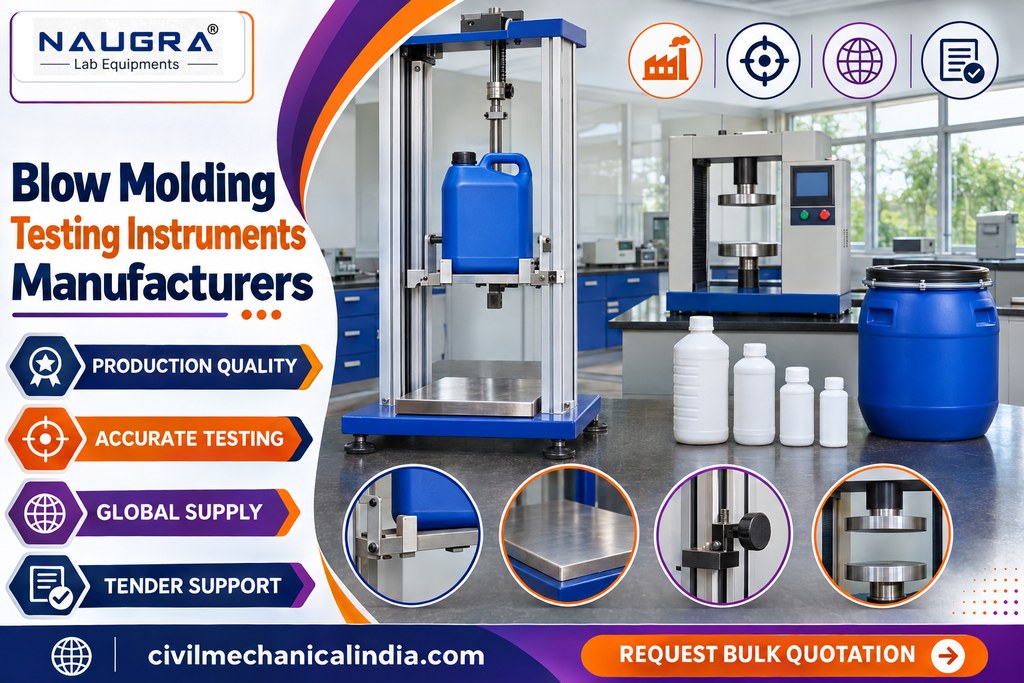
We manufacture blow molding testing instruments in India for producers of extrusion blow moulded bottles, cans and drums. These containers carry lubricants, chemicals, detergents, milk and edible oil, and they must not leak, crack or collapse. The model codes below are for tender buyers in Africa and South America.
Our blow molding testing instruments range
| Product | Model code | Use |
|---|---|---|
| Bottle Burst Pressure Tester for Blow Molded HDPE Containers | CMI-IND-0271 | Burst pressure of blow moulded HDPE containers |
| Drop Impact Tester for Blow Molded Plastic Containers | CMI-IND-0274 | Drop impact of filled containers |
| Compression Tester for Blow Molded Drums | CMI-IND-0273 | Compression and stacking strength of drums |
| Bottle Squeeze and Panel Rigidity Tester | CMI-IND-0272 | Squeeze and panel rigidity of bottles |
| Environmental Stress Crack Test Bath for Blow Molded Bottles | CMI-IND-0275 | Stress crack resistance in detergent solution |
| Gloss and Haze Meter for Blow Molded Bottles | CMI-IND-0276 | Gloss and haze of bottle surfaces |
Ten instruments are shown on our Blow Molding Testing Instruments page.
Tests and applications
| Container | Main risks | Tests |
|---|---|---|
| Detergent and shampoo bottles | Stress cracking, panel collapse | Stress crack bath, squeeze test |
| Lubricant cans | Leaks, drop damage | Burst, drop |
| Milk and juice bottles | Weak seams, low top load | Top load, drop |
| Chemical drums | Stacking failure, leakage | Compression, drop, pressure |
Extrusion blow moulding leaves a weld, the pinch-off, at the base of every container. It is the usual point of failure in drop and pressure tests, so those tests are the first line of control.
Stress cracking is the hidden risk with polyethylene. Detergents and some oils attack stressed plastic slowly, and bottles that pass every short-term test may split on the shelf weeks later. A stress crack bath accelerates the process so the fault is found in the laboratory.
Containers for dangerous goods must pass drop, stack and pressure tests defined in transport regulations before they can be marked and sold for that use.
What to specify in a tender
- Container types and volumes, from small bottles to drums.
- Products filled, especially chemicals and detergents.
- Drop heights and orientations required.
- Pressure range and compression capacity.
- Regulations or customer standards that apply.
Controlling quality in a blow moulding plant
Weigh containers continuously, since weight tracks parison thickness. Measure wall thickness at marked points, particularly corners and the base, where material thins.
Drop test filled containers at start-up and after any change of resin, colour or mould. Condition them at low temperature if your standard requires it, because polyethylene is more brittle when cold.
Run stress crack tests on each new resin lot and each new bottle design. Results take days, so plan them ahead of production. Leak test containers with closures fitted, since many leaks come from the neck and cap, and keep records by machine and mould.
Markets we supply in Africa and South America
Lubricants, agrochemicals, detergents and edible oil are all packed in blow moulded containers made locally in both regions.
| Country | Nominal mains supply | Usual port of entry | Note for buyers |
|---|---|---|---|
| Sierra Leone | 230 V, 50 Hz | Freetown | Edible oil and water containers are produced for the domestic market. |
| Comoros | 220 V, 50 Hz | Moroni | Imported and local containers serve small-scale packers. |
| Equatorial Guinea | 220 V, 50 Hz | Malabo or Bata | The oil industry uses lubricant and chemical containers that must not leak. |
| Eswatini | 230 V, 50 Hz | Durban or Maputo, then road | Agrochemical and beverage packers buy locally moulded containers. |
| Chile | 220 V, 50 Hz | San Antonio or Valparaíso | Mining chemicals and wine industry supplies are packed in tested drums and cans. |
| Ecuador | 120 V, 60 Hz | Guayaquil | Supply is 120 V at 60 Hz. Motorised testers are specified to suit. |
Why source from us
- Pressure, drop, compression and durability testers from one manufacturer.
- Equipment sized for bottles through to drums.
- Resin and closure testers on the same order.
- Installation and training available.
Frequently asked questions
Can the drop tester handle drums?
Tell us the largest filled weight and dimensions. We confirm capacity in the offer.
Which solution is used for stress crack tests?
The standard names the reagent. Tell us your method and we state what is supplied.
Are jerry can testers available?
Yes. See our Jerry Cans Testing Instruments range.
Send us your tender requirements
Container makers supplying chemical, lubricant or food companies are asked for test evidence with every new item. Send us your tender requirements and we will reply to each line with the instrument we offer, its model code, capacity and fixtures.
We can supply the blow moulding laboratory from India: burst testers, drop testers, compression testers, squeeze testers, stress crack baths, thickness gauges, leak testers, torque testers, gloss meters, melt flow and density testers. Equipment is sized for your largest and smallest containers.
Tell us the containers you make, the products they carry, any transport regulations that apply and the destination. Send the list through our contact page. We reply with an itemised quotation and delivery time. Capacities depend on container size, so each tender is quoted individually, with fixtures for each container listed line by line.
For containers that must be approved for dangerous goods, tell us the regulation and packing group. We will set out which of our testers support the drop, stacking and pressure tests the approval body will ask you to demonstrate, so that the laboratory is specified correctly from the start.