
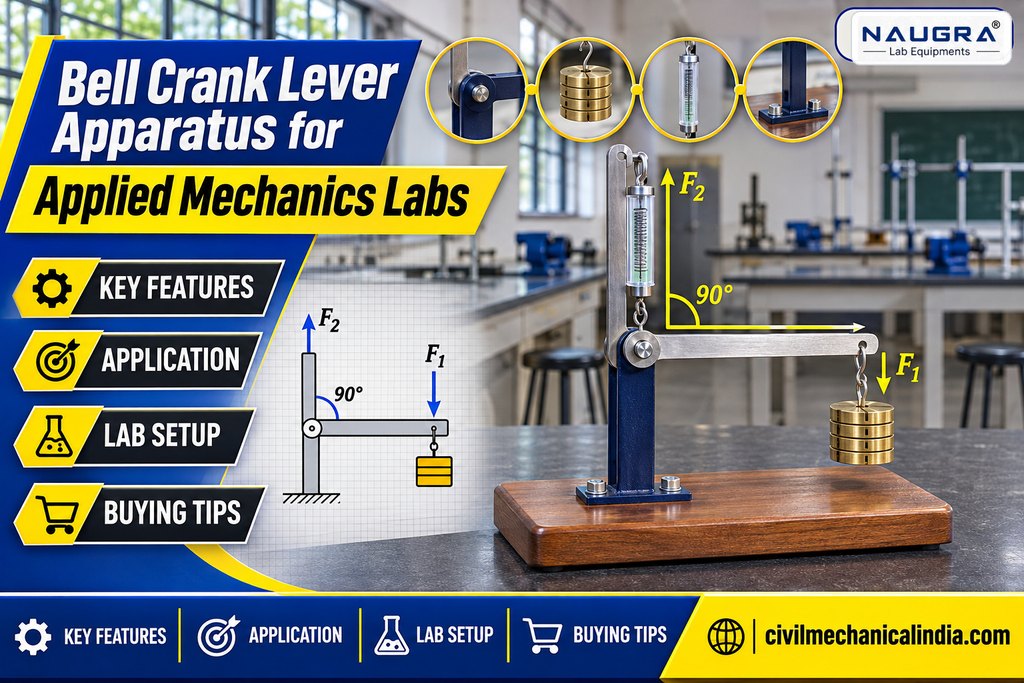
The bell crank lever apparatus lets first-year engineering students verify the principle of moments on an L-shaped lever, a part they will later meet in brake linkages, governors and aircraft controls. We supply applied mechanics apparatus from India. This guide is for lecturers and procurement staff in Nigeria, South Africa, Egypt, Kenya and Ethiopia.
What the bell crank lever experiment shows
A bell crank lever has two arms at an angle, usually 90 degrees, joined at a fixed pivot. A load hung from the horizontal arm tries to turn the lever one way. A force on the other arm, read from a spring balance, holds it in place. At balance:
load x length of load arm = effort x length of effort arm.
Students hang different weights at different distances, read the spring balance each time, and compare the reading with the calculated value. The percentage error shows the effect of friction at the pivot and the weight of the lever itself.
What a good apparatus includes
| Part | What to look for |
|---|---|
| Lever | Rigid, with arms of clearly marked length |
| Pivot | Free-running pin or bearing with little friction |
| Horizontal arm | Several hanger positions at known distances |
| Spring balance | Range matched to the weights supplied |
| Weights | Slotted set with hanger |
| Base and stand | Heavy enough not to tip under full load |
The apparatus is purely mechanical and needs no power.
Related apparatus in our range
Our website does not show a dedicated page for the crank lever apparatus, so name it in your enquiry and we will quote it. The following statics and machines experiments are listed in our Applied Mechanics Lab Equipments category.
| Product | Code | Principle taught |
|---|---|---|
| Universal Force Table | APE-0025 | Triangle, parallelogram and polygon of forces |
| Wheel And Axle Apparatus | APE-0028 | Mechanical advantage and velocity ratio |
| Worm And Wheel Apparatus | APE-0031 | Velocity ratio and efficiency of a worm drive |
| Winch Crab Single Purchase Apparatus | APE-0030 | Efficiency of a single purchase winch |
| Friction Slide Apparatus | APE-0011 | Coefficient of friction on a plane |
| Jib Crane Apparatus | APE-0016 | Forces in the members of a jib crane |
Our product page for the universal force table describes a 40 cm aluminium disc graduated in 360 degrees with five sliding clamp pulleys and five sets of slotted weights.
How to choose
- Read the syllabus. Most first-year mechanics courses list ten to fifteen experiments, including a simple wheel and axle, screw jack, friction apparatus and pulley systems.
- Buy one apparatus per group for the common experiments.
- Prefer metal construction with a painted or plated finish.
- Check that weights and hangers are included, not listed as extras.
- Ask for a lab manual with each experiment.
What drives the price
We quote apparatus individually or as a complete lab. Cost depends on:
- Size and material.
- Whether weights, hangers and balances are included.
- Wall-mounted or bench-mounted design.
- Number of sets.
- Packing and freight, since cast bases are heavy.
A full applied mechanics lab ordered together is cheaper to ship than piecemeal purchases, because small items travel inside the crates of larger ones.
Import and site notes by country
No electrical supply is needed. Storage and handling are the practical concerns.
| Country | Nominal mains supply | Usual port of entry | Note for this equipment |
|---|---|---|---|
| Nigeria | 230 V, 50 Hz | Lagos (Apapa or Tin Can Island) | Engineering faculties have very large first-year classes. Order several sets of each common experiment. |
| South Africa | 230 V, 50 Hz | Durban | Universities of technology run practicals in rotation. Wall-mounted versions save bench space. |
| Egypt | 220 V, 50 Hz | Alexandria | Dry air is kind to steel, but sand in pivots raises friction. Wipe and oil pins each term. |
| Kenya | 240 V, 50 Hz | Mombasa | Technical institutes teach mechanics at certificate and diploma level. Simple, sturdy sets suit both. |
| Ethiopia | 220 V, 50 Hz | Djibouti, then road or rail (landlocked) | Rapid university expansion means new labs from scratch. Ask for a complete package with manuals. |
Mistakes to avoid
- Ignoring the weight of the lever in calculations.
- Using a spring balance with too coarse a scale.
- Letting the lever rest off horizontal when taking readings.
- Losing slotted weights for lack of a storage box.
Frequently asked questions
Which other experiments belong with the bell crank lever?
Typical lists include a double purchase crab winch, miniature screw jack, pulley clamp sets, Hooke's law apparatus and simple pendulum apparatus. Send your list and we will match it.
Is the apparatus suitable for polytechnics as well as universities?
Yes. The experiment is the same at both levels, with more error analysis expected at degree level.
Do you supply mechanisms and models too?
Yes. Gear trains, linkages and cut models are listed under Various Engineering Models, Charts and Accessories.
Request a quotation
Send your experiment list and group count through our contact page. We will quote each apparatus with weights and manuals. See the rest of our Mechanical Engineering Lab Equipment range for other labs.