
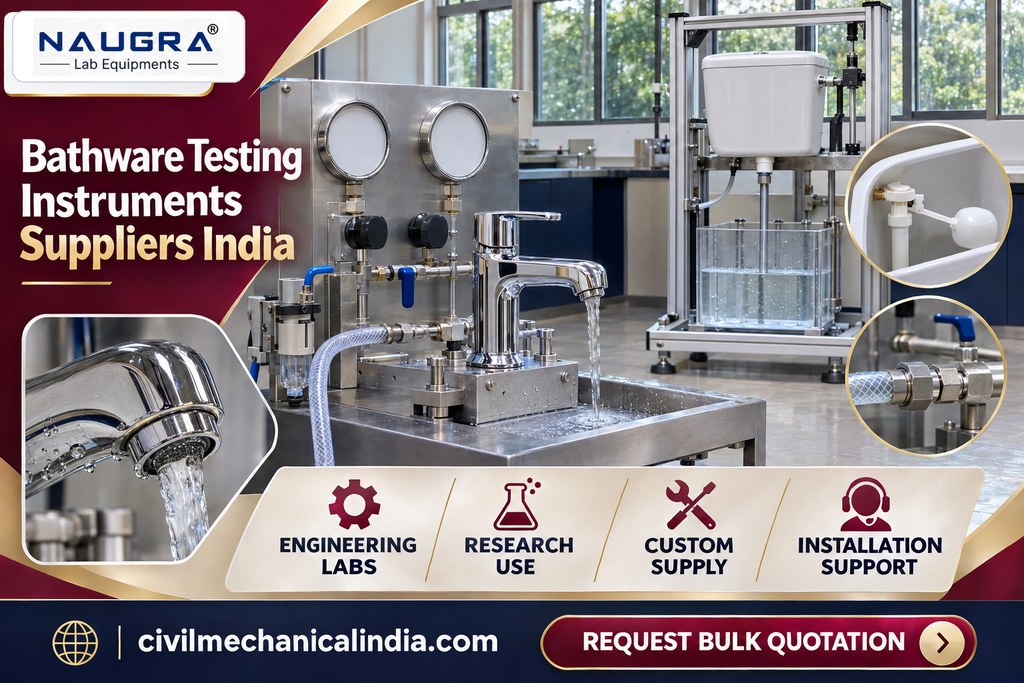
We supply bathware testing instruments from India to makers of faucets, showers, cisterns, sanitaryware, bathtubs and bath accessories, and to the standards bodies that certify them. Bathroom products must hold water pressure, flush efficiently, resist corrosion and stay intact for years. The model codes below are for tender buyers in Africa and South America.
Our bathware testing instruments range
| Product | Model code | Use |
|---|---|---|
| Faucet Hydrostatic Pressure and Leak Test Bench | CMI-IND-0555 | Hydrostatic pressure and leakage of faucets |
| Cistern Flush Volume and Leak Test Rig for WC | CMI-IND-0552 | Flush volume and leakage of WC cisterns |
| Autoclave Crazing Resistance Tester for Glazed Sanitaryware | CMI-IND-0551 | Crazing resistance of glazed sanitaryware |
| Neutral Salt Spray Chamber for Chrome Plated Bath Fittings | CMI-IND-0556 | Corrosion of chrome plated fittings by salt spray |
| Coulometric Coating Thickness Tester for Chrome and Nickel Plating | CMI-IND-0553 | Thickness of chrome and nickel plating |
| Falling Ball Impact Rig for Bathtubs and Trays | CMI-IND-0554 | Impact resistance of bathtubs and shower trays |
Ten instruments are shown on our Bathware Testing Instruments page.
Tests and applications
| Product | Tests |
|---|---|
| Faucets and valves | Pressure, leakage, flow rate, endurance, plating |
| Cisterns and WCs | Flush volume, leakage, flushing performance |
| Glazed sanitaryware | Crazing, water absorption, load |
| Plated accessories | Salt spray, plating thickness, adhesion |
| Baths and trays | Impact, deflection under load, surface resistance |
Water efficiency rules are spreading. Flush volume limits for cisterns and flow limits for taps are written into building codes in a growing number of countries, and compliance has to be measured.
Faucets work under mains pressure for decades. Pressure and leak tests are done on every unit in good factories, and endurance tests on samples confirm cartridge life. Plating protects brass from corrosion, and salt spray with thickness measurement is the standard control.
Glazed sanitaryware can develop fine cracks called crazing if body and glaze are poorly matched. An autoclave test brings out the fault in hours.
What to specify in a tender
- Products: fittings, ceramic ware, acrylic baths or accessories.
- Standards and building codes that apply.
- Pressure and flow ranges for fittings tests.
- Chamber size and test duration for salt spray.
- Autoclave pressure and specimen size for crazing tests.
Laying out a bathware test laboratory
Wet tests need a dedicated area with a drained floor, a pump set giving controlled pressure and flow, and calibrated gauges and flow meters. Mount fittings as they would be installed, and test with hot and cold water where the standard requires it.
Keep salt spray chambers in a separate ventilated room, because the mist corrodes other equipment. Plating thickness instruments belong in a clean, dry laboratory.
Ceramic tests use an autoclave, a drying oven and load frames. Handle large pieces with lifting aids. Record every test against the product's batch or casting date, since ceramic faults often relate to a particular kiln firing or glaze batch.
Markets we supply in Africa and South America
Housing, hotels and public buildings under construction in both regions all need sanitaryware and fittings, increasingly made locally.
| Country | Nominal mains supply | Usual port of entry | Note for buyers |
|---|---|---|---|
| Liberia | 120 V, 60 Hz in most areas | Monrovia | Supply is 120 V at 60 Hz in most areas. Pumps and chambers are specified accordingly. |
| Seychelles | 240 V, 50 Hz | Victoria | Hotels in a marine climate demand corrosion-resistant fittings. |
| São Tomé and Príncipe | 220 V, 50 Hz | São Tomé | Imported bathware is checked for basic conformity. |
| Gambia | 230 V, 50 Hz | Banjul | Tourism and housing projects drive demand for durable fittings. |
| Brazil | 127 V or 220 V, 60 Hz (varies by state) | Santos | A large sanitaryware and fittings industry with strict water efficiency rules. |
| Peru | 220 V, 60 Hz | Callao | Water scarcity along the coast makes low-flow fittings a priority. |
Why source from us
- Hydraulic, ceramic, corrosion and impact testers from one supplier.
- Rigs built for the product sizes you make.
- Ceramic and coating testers on the same order.
- Installation and training available.
Frequently asked questions
Do you supply faucet endurance testers?
Yes. Tell us the number of stations and the cycle your standard requires.
How large is the salt spray chamber?
We state the volume in the offer. Tell us the largest part and batch size.
Are ceramic body tests covered?
Ceramic instruments are listed in our Porcelains and Ceramics Testing Instruments range.
Send us your tender requirements
Fittings factories, sanitaryware plants and national laboratories usually specify equipment from the product standards. Send us your tender requirements and we will answer each line with the instrument we offer, its model code and capacity.
We can supply the bathware laboratory from India: faucet pressure and leak benches, flow and endurance testers, cistern flush rigs, crazing autoclaves, salt spray chambers, plating thickness testers, impact rigs, load frames, ovens and balances.
Tell us the products you make or certify, the standards and codes that apply and the destination port. Use our contact page to send the details. We reply with an itemised quotation and delivery period.
Rigs are sized for your products, so each tender is quoted on its own scope. Importers and hotel groups can ask for a smaller set to check plating and leakage on deliveries, so that faulty consignments are found before fittings are installed.