
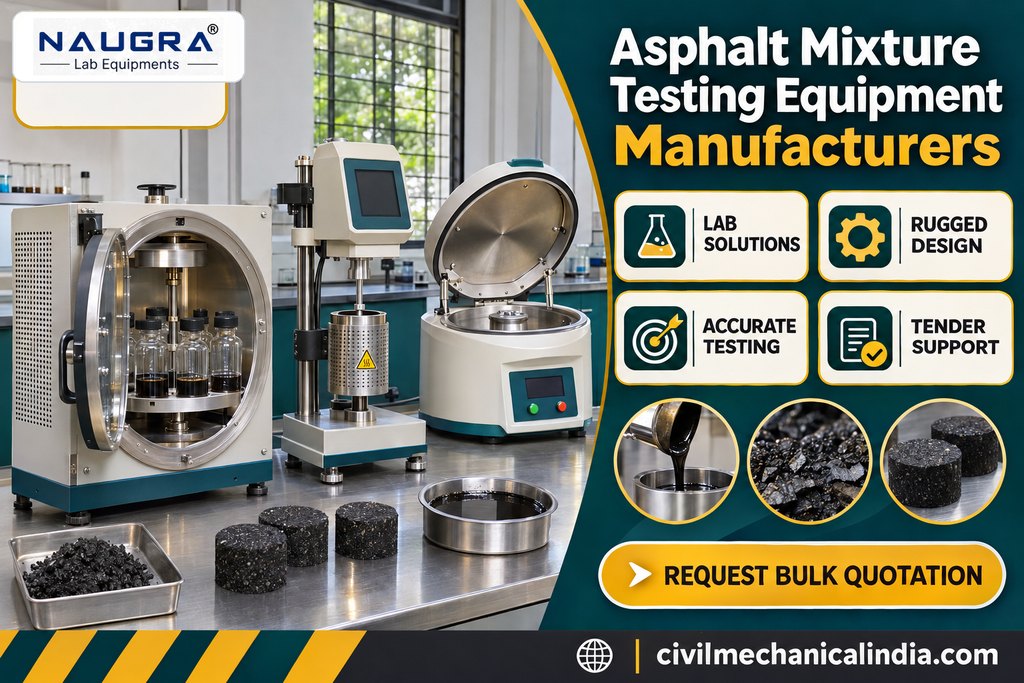
Our asphalt mixture testing equipment serves refineries, bitumen terminals, road authorities and contractor laboratories that need automatic, repeatable results on binders and mixes. We manufacture it in India. The model codes below are for buyers in Africa and South America preparing tenders.
Our asphalt mixture testing equipment range
| Product | Model code | Use |
|---|---|---|
| Automatic Bitumen Softening Point Tester Ring and Ball | CMI-IND-0021 | Softening point with automatic detection |
| Bitumen Ductility Testing Machine with Cooling Bath | CMI-IND-0022 | Ductility at controlled low temperature |
| Rolling Thin Film Oven for Bitumen Ageing | CMI-IND-0027 | Short-term ageing of binder |
| Rotational Viscometer for Bitumen at Elevated Temperature | CMI-IND-0028 | Binder viscosity at mixing and compaction temperatures |
| Centrifuge Extractor for Bitumen Content in Asphalt Mix | CMI-IND-0025 | Binder content of asphalt mix by extraction |
| Indirect Tensile Strength Test Frame for Asphalt Specimens | CMI-IND-0026 | Tensile strength and moisture damage of compacted specimens |
Ten products are listed on our Asphalt and Bitumen Mixture Testing Equipment page.
Tests and applications
| Material | Tests | Purpose |
|---|---|---|
| Binder as supplied | Softening point, ductility, viscosity, flash point | Confirm the grade |
| Binder after ageing | Thin film oven, then repeat tests | Predict hardening in service |
| Loose mix | Extraction and grading | Check plant production |
| Compacted mix | Indirect tensile strength | Assess cracking and stripping |
Viscosity measured at high temperature sets the mixing and compaction temperatures for a job. Indirect tensile strength, tested dry and after soaking, shows whether a mix will resist moisture damage. Both tests are now common in specifications for heavily trafficked roads.
Refineries and terminals test every batch they release. Road authorities repeat the tests on delivery, and contractors test again at the plant. Agreement between those three sets of results depends on equipment that follows the same method exactly.
What to specify in a tender
- The binder specification in force, which lists the tests and temperatures.
- Automatic or manual operation for softening point and ductility.
- Spindle sizes and temperature range for the viscometer.
- Solvent type and bowl capacity for the extractor.
- Specimen diameter and loading strips for tensile testing.
Setting up binder and mix testing
Binder tests need clean, temperature-controlled conditions. Give the ductility machine and softening point tester a bench away from ovens and draughts. The rolling thin film oven needs an air supply and extraction, and it should stand near the bench where aged samples are poured for further tests.
Mix testing is hotter and dirtier. Put the extractor in a ventilated area and store solvent safely. The tensile test frame needs a water bath for conditioning specimens and a compactor nearby to prepare them.
Plan sample flow so binder tins, loose mix and compacted specimens do not cross paths. Label everything with the plant, date and lorry or tank number, because results are used to accept or reject deliveries. Keep retained samples for the period your contract specifies.
Markets we supply in Africa and South America
Road networks in both regions carry heavier traffic each year, and binder specifications are tightening in response.
| Country | Nominal mains supply | Usual port of entry | Note for buyers |
|---|---|---|---|
| Guinea-Bissau | 220 V, 50 Hz | Bissau | Tender documents are in Portuguese. Send the original wording with your enquiry. |
| Cabo Verde | 230 V, 50 Hz | Praia | An island nation where road materials are imported and checked on arrival. |
| Nigeria | 230 V, 50 Hz | Lagos (Apapa or Tin Can Island) | Refineries, terminals and many contractors all run binder laboratories. |
| Algeria | 230 V, 50 Hz | Algiers | A large road network and local bitumen production keep testing volumes high. |
| Argentina | 220 V, 50 Hz | Buenos Aires | Long highways across varied climates demand careful binder selection. |
| Colombia | 110 V, 60 Hz | Cartagena or Buenaventura | Supply is 110 V at 60 Hz. Ovens and baths are built to suit. |
Why source from us
- Binder and mix testers from one manufacturer.
- Automatic versions for laboratories with heavy workloads.
- Marshall equipment and aggregate testers on the same order.
- Installation, commissioning and training offered.
Frequently asked questions
Do you supply flash point testers for bitumen?
Yes. An open cup flash and fire point tester is listed in the same category.
Is the Marshall test covered?
Marshall apparatus is listed under Bitumen / Asphalt Testing Lab Equipment and can be added to the same offer.
Which viscosity range does the viscometer cover?
We state the range and spindles in the quotation. Tell us the binders you test, including any modified grades.
Send us your tender requirements
Binder and asphalt specifications are detailed, and the equipment has to match them exactly. Send us your tender requirements and we will respond to each clause with the instrument we offer, its model code and the method it follows, noting any deviation plainly.
We can supply the complete binder and mix laboratory from India: automatic softening point and ductility testers, thin film ovens, viscometers, flash point testers, extractors, tensile test frames, Marshall compactors and stability machines, with baths, ovens and balances. Glassware, rings, moulds and filter papers are quoted as separate lines.
Let us have the specification, the number of samples per day and the destination. Contact us through the contact page and you will receive an itemised quotation with delivery period. The scope of every tender differs, so we do not publish a price list. We quote what you actually need.