
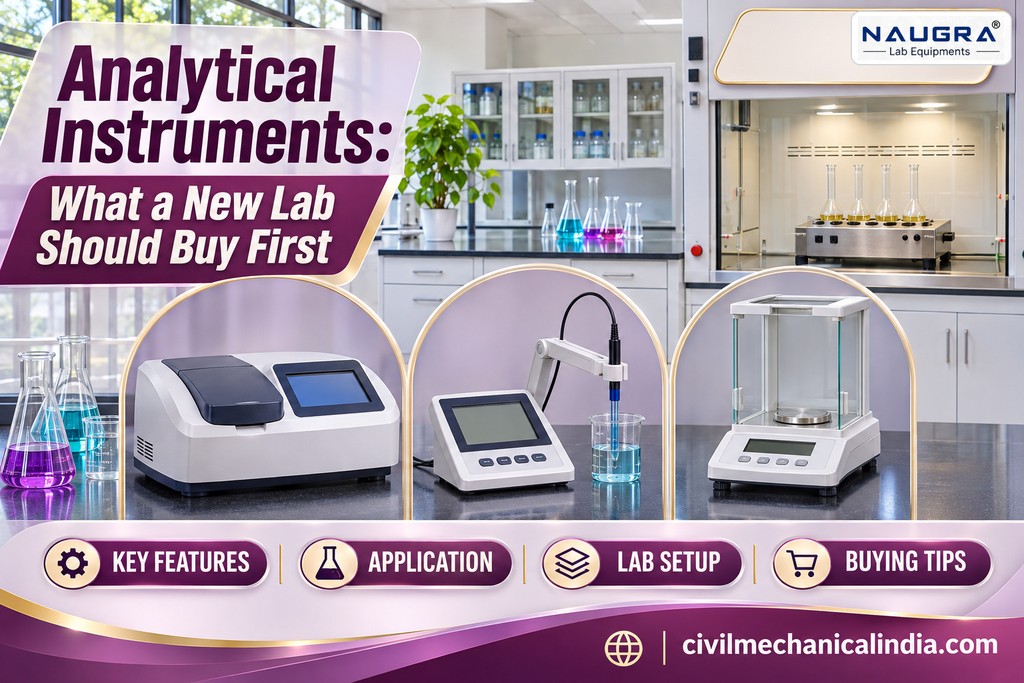
Analytical instruments tell you what is in a sample and how much of it is there. A new laboratory cannot buy everything at once, so the order of purchase matters. We manufacture and supply these instruments from India, and this guide gives buyers in Botswana, Nigeria, South Africa, Egypt and Kenya a sensible sequence.
First, the support equipment
No analytical result is better than the weighing, heating and water behind it. Before any advanced chemical instrument, a lab needs:
- An analytical balance.
- A drying oven and a muffle furnace.
- A source of distilled water.
- A hot plate, a water bath and a stirrer.
- Glassware of the right class.
These items are in daily use in every method.
An analytical instruments list by priority
The table groups instruments in the order most new labs buy them. Each links to a category on our website.
| Priority | Instrument group | Category on our website |
|---|---|---|
| 1 | pH, conductivity and ion meters | Electrochemistry Instruments |
| 2 | Distilled water supply | Water Still |
| 3 | Nitrogen and protein determination | Kjeldahl Distillation Unit |
| 4 | Sodium and potassium determination | Flame Photometer |
| 5 | Oxygen demand of water and effluent | COD Digester |
| 6 | Fat and oil extraction | Soxhlet Extraction Unit |
A laboratory pH meter comes first because almost every wet chemistry method starts or ends with a pH check. Our electrochemistry range also lists a Potentiometric Auto Titrator with Stirrer, described on the site as having a motorised burette and magnetic stirrer with endpoint detection by pH or mV.
How to choose each instrument of laboratory use
- Start from the method. The standard method names the technique and often the detection limit.
- Count samples per day. Six-place digesters and multi-position stirrers pay for themselves in busy labs.
- Check consumables. Lamps, electrodes, filters and reagents must be available in your country.
- Ask about training. A lab machine nobody can operate is wasted money.
- Plan the room: fume extraction for digesters, stable benches for balances.
A digital spectrophotometer is usually the first optical instrument. It covers many colour-based water, food and soil methods with one unit.
Sample preparation deserves the same attention as the instrument. Digestion blocks, extraction units and furnaces turn a raw sample into a solution the instrument can read. If preparation is slow or inconsistent, an expensive analyser will sit idle or report poor data, so size both stages for the same daily sample load.
What drives the price
We quote per specification. Costs rise with:
- Detection limit and accuracy.
- Degree of automation.
- Number of sample positions.
- Software and data output.
- Accessories and starter consumables.
- Installation and training on site.
Automation reduces operator time, not reagent cost. Choose it where sample numbers justify it.
Import and site notes by country
Analytical instruments are sensitive to power quality and climate. Confirm supply details and plan for air conditioning.
| Country | Nominal mains supply | Usual port of entry | Note for this equipment |
|---|---|---|---|
| Botswana | 230 V, 50 Hz | Durban or Walvis Bay, then road (landlocked) | Water and mineral labs dominate demand. Ion meters and conductivity meters are early purchases. |
| Nigeria | 230 V, 50 Hz | Lagos (Apapa or Tin Can Island) | Food and agro-processing labs need protein testing. A Kjeldahl digestion unit and distillation set come early. |
| South Africa | 230 V, 50 Hz | Durban | Accredited labs need calibration certificates and traceable records. Request them in the enquiry. |
| Egypt | 220 V, 50 Hz | Alexandria | Fertiliser and soil labs handle heavy sample loads. Multi-place digesters reduce queues. |
| Kenya | 240 V, 50 Hz | Mombasa | Tea, coffee and horticulture exporters test residues and nutrients. Plan a clean, air-conditioned instrument room. |
Mistakes to avoid
- Buying an advanced laboratory machine before the balance and water supply are in place.
- Ignoring consumable costs over five years.
- Skipping fume extraction for acid digestion.
- Ordering without confirming the voltage.
- Having no trained operator on the day the instrument arrives.
Frequently asked questions
Which instrument should a water lab buy first?
A pH meter, then conductivity and turbidity meters, then a spectrophotometer for colour-based tests.
Do you supply complete analytical labs?
Yes. Send the methods you must run. We quote instruments and support equipment from our Analytical Lab Instruments range as one package.
Is training included?
We offer installation, commissioning and training. Ask for it to be listed in the quotation.
Ask for an itemised offer
Tell us your methods, sample load and power supply through our contact page. We will propose a phased purchase plan and quotation.