
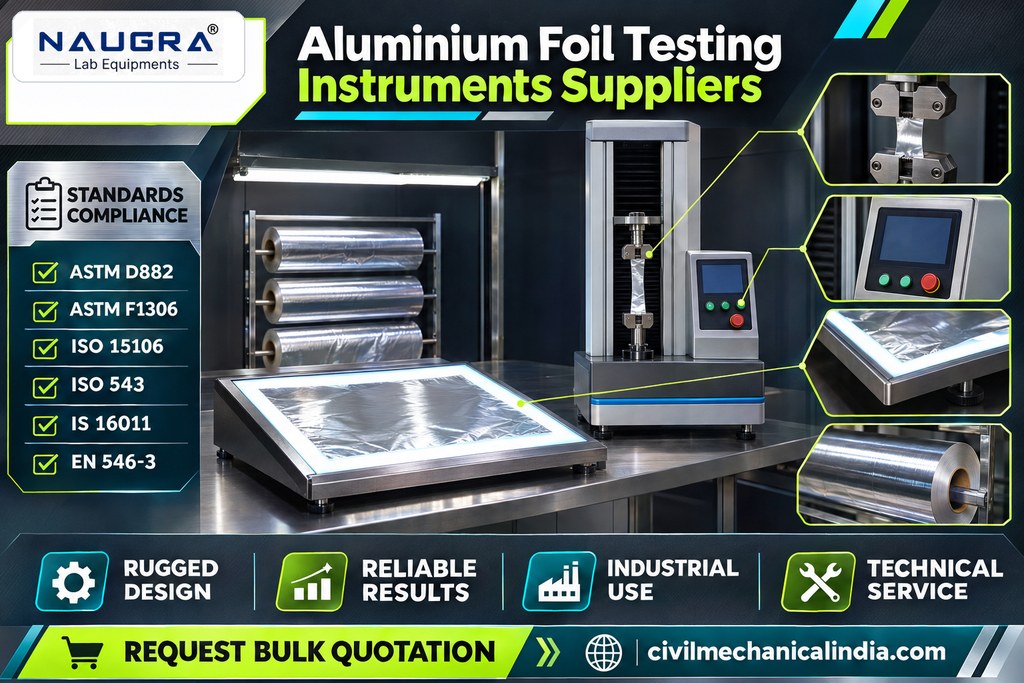
Our foil testing instruments are used by aluminium foil rolling mills, converters who coat and laminate foil, and the food and pharmaceutical companies that seal products with it. Foil is valued as a near-perfect barrier, and testing confirms that it remains one. We manufacture the instruments in India. The model codes below are for tender buyers in Africa and South America.
Our foil testing instruments range
| Product | Model code | Use |
|---|---|---|
| Aluminium Foil Pinhole Detector with Light Table | CMI-IND-0341 | Pinholes seen against a light table |
| Aluminium Foil Tensile and Elongation Tester | CMI-IND-0342 | Tensile strength and elongation of foil |
| Foil Bursting Strength Tester with Pneumatic Clamping | CMI-IND-0343 | Bursting strength with pneumatic clamping |
| Foil Coating Adhesion Cross Cut and Peel Tester | CMI-IND-0344 | Adhesion of coatings by cross cut and peel |
| Foil Heat Seal Strength Tester for Lidding Foil | CMI-IND-0345 | Seal strength of lidding foil |
| Foil Surface Roughness Tester for Rolled Aluminium | CMI-IND-0346 | Surface roughness of rolled foil |
Ten instruments are shown on our Foil Testing Instruments page.
Tests and applications
| Foil use | Critical property | Test |
|---|---|---|
| Blister lidding | Pinholes, seal strength | Light table, seal tester |
| Household and container foil | Thickness, tensile, elongation | Gauge, tensile tester |
| Laminates for pouches | Coating adhesion, bond | Cross cut, peel |
| Dairy and beverage lids | Seal and peel force | Seal tester |
| Printed foil | Surface quality | Roughness tester |
Pinholes are the defining test for thin foil. The thinner the foil, the more likely tiny holes appear during rolling, and each one lets moisture or oxygen through. Counting pinholes per square metre on a light table is the standard check.
Tensile strength and elongation decide whether foil runs on converting and packing machines without tearing. Lidding foil must seal firmly to the blister or cup and then peel cleanly, so seal strength is tested at the conditions used on the customer's machine.
Pharmaceutical packers audit their foil suppliers and expect certificates covering thickness, pinholes, coating weight and seal strength for every lot.
What to specify in a tender
- Foil gauges, alloys and tempers.
- Coated, lacquered or laminated structures.
- Pinhole inspection area and light level.
- Sealing temperature, pressure and time for seal tests.
- Sample cutters and grips suited to thin foil.
Testing thin foil without damaging it
Foil creases and tears easily, and a damaged sample gives a false result. Cut tensile strips with a sharp double-blade cutter, never with scissors, and handle them with gloves by the ends only. Use grips with smooth, aligned faces.
Inspect for pinholes in a darkened booth so that small holes are visible. Mark the inspected area and count consistently, following the method your customers use.
For seal tests, record temperature, pressure and dwell time with every result. Coating weight is usually checked by weighing a cut area before and after removing the coating, so a precise cutter and analytical balance belong in the same laboratory.
Markets we supply in Africa and South America
Pharmaceutical packing, dairy and confectionery all rely on foil, much of it converted locally in both regions.
| Country | Nominal mains supply | Usual port of entry | Note for buyers |
|---|---|---|---|
| Rwanda | 230 V, 50 Hz | Dar es Salaam or Mombasa, then road | New pharmaceutical packing operations need verified blister foil. |
| Zimbabwe | 240 V, 50 Hz | Beira or Durban, then road | Food and pharmaceutical packers check imported foil on arrival. |
| Mali | 220 V, 50 Hz | Dakar or Abidjan, then road | Small converters and packers benefit from basic pinhole and seal checks. |
| Sudan | 230 V, 50 Hz | Port Sudan | Local medicine production relies on foil that meets pharmacopoeia requirements. |
| Bolivia | 230 V, 50 Hz | Arica in Chile, then road | Instruments travel by road to highland cities. Delicate items are packed with care. |
| Uruguay | 220 V, 50 Hz | Montevideo | Dairy processors use lidding foil and test seals routinely. |
Why source from us
- Barrier, strength, seal and surface testers from one supplier.
- Cutters and grips designed for thin foil.
- Film and laminate testers on the same order.
- Installation and training available.
Frequently asked questions
Do you supply thickness gauges for foil?
Yes. Tell us the gauge range and resolution you need.
Can the seal tester match my packing machine conditions?
Tell us temperature, pressure and dwell time. We confirm the ranges in the offer.
Are blister leak testers available?
Yes. They are listed in our Pharmaceutical Testing Instruments range.
Send us your tender requirements
Foil suppliers to pharmaceutical and food companies are judged by their certificates. Send us your tender requirements, and we will answer each line with the instrument we offer, its model code and the accessories included.
We can supply the foil laboratory from India: pinhole detectors, thickness gauges, tensile and bursting testers, coating adhesion kits, heat seal testers, roughness testers, sample cutters, balances and ovens. For converters, laminate bond, friction and barrier instruments are added to the same offer.
Tell us the foils you make or buy, the end uses and the destination. Send the details through our contact page. We reply with an itemised quotation and delivery period.
Gauge ranges and seal conditions differ by application, so each tender is quoted on its own list. Every cutter, grip and seal jaw is shown separately.
If your customers audit you against a pharmacopoeia or a brand owner's packaging standard, send the relevant pages. We will map each clause to an instrument, so the laboratory you buy covers every value that must appear on your certificate.