
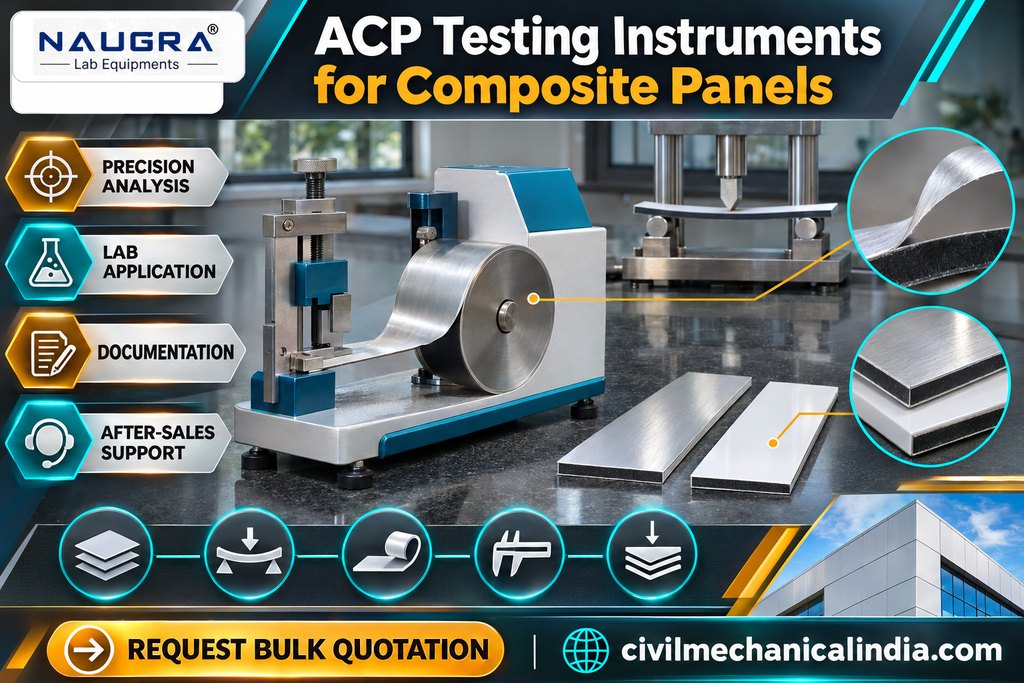
Our ACP testing instruments are made for producers of aluminium composite panels, cladding fabricators, building inspectors and standards bodies. A panel is two thin aluminium skins bonded to a core, and it must stay bonded, stay flat, keep its colour and resist fire. We manufacture the instruments in India. The model codes below are for tender buyers in Africa and South America.
Our ACP testing instruments range
| Product | Model code | Use |
|---|---|---|
| ACP Peel Strength Drum Peel Tester for Aluminium Skin | CMI-IND-0486 | Peel strength between aluminium skin and core |
| ACP Flexural and Core Shear Strength Testing Machine | CMI-IND-0484 | Flexural strength and core shear |
| ACP Impact Resistance Falling Weight Tester for Panels | CMI-IND-0485 | Impact resistance by falling weight |
| ACP Fire Core Combustibility Test Apparatus | CMI-IND-0483 | Combustibility of the core material |
| ACP Coating Thickness and Adhesion Cross Cut Test Kit | CMI-IND-0482 | Coating thickness and cross cut adhesion |
| ACP Bond Integrity Boiling Water and Humidity Test Bath | CMI-IND-0481 | Bond integrity after boiling water and humidity |
Ten instruments are shown on our ACP-Aluminium Composite Panel Testing Instruments page.
Tests and applications
| Requirement | Test | Why it matters |
|---|---|---|
| Skins stay bonded | Drum peel, before and after boiling | Delamination on facades |
| Panel stiffness | Flexural strength | Flatness under wind load |
| Damage resistance | Impact | Dents during installation and use |
| Fire safety | Core combustibility | Fire spread on building exteriors |
| Finish durability | Coating thickness, adhesion, weathering | Fading and peeling |
Fire performance is the first question asked about cladding today. After several serious facade fires around the world, many countries restrict panels with combustible cores on tall buildings. Regulators and developers want test evidence for the core material.
Peel strength is the routine production test. It is repeated after boiling or humidity exposure, because moisture and heat on a sunlit facade attack a weak bond over time.
Coating tests check the paint system, usually a fluoropolymer or polyester finish, for thickness and adhesion. Fabricators also need to know that panels can be routed and folded without the skin cracking.
What to specify in a tender
- Panel thickness, skin thickness and core type.
- Standards and building regulations that apply.
- Peel method and specimen width.
- Span and loading arrangement for flexural tests.
- Fire test method required by your authority.
Testing panels in production and on receipt
A panel line runs continuously, so sample at intervals across the width and at each coil change. Peel strength varies from edge to centre if lamination temperature is uneven.
Cut specimens with a clean saw and avoid heating the edge, which weakens the bond locally. Condition them before testing and record the line speed and temperatures in force when the sample was taken.
Fabricators and inspectors receiving panels should check skin thickness, coating thickness and peel strength on each lot. Markings on protective film are not proof. Keep cut samples from every project with the delivery documents, since questions about cladding often arise years after installation.
Markets we supply in Africa and South America
Commercial building in fast-growing cities has made composite panels a common facade material in both regions.
| Country | Nominal mains supply | Usual port of entry | Note for buyers |
|---|---|---|---|
| Mali | 220 V, 50 Hz | Dakar or Abidjan, then road | New commercial buildings use cladding panels that are mostly imported. |
| Sudan | 230 V, 50 Hz | Port Sudan | Imported panels should be verified on arrival before installation. |
| DR Congo | 220 V, 50 Hz | Matadi, or Dar es Salaam for the east | Rapid urban construction is increasing cladding use and the need for checks. |
| Botswana | 230 V, 50 Hz | Durban or Walvis Bay, then road | Building regulations and insurers are paying closer attention to facade materials. |
| Guyana | 120 V or 240 V, 60 Hz (varies by area) | Georgetown | Supply is 60 Hz and voltage varies by area. Confirm before ordering. |
| Suriname | 127 V, 60 Hz | Paramaribo | Importers and builders benefit from basic peel and thickness checks. |
Why source from us
- Bond, strength, fire and coating testers from one manufacturer.
- Instruments for both producers and inspectors.
- Weathering and colour instruments on the same order.
- Installation and training available.
Frequently asked questions
Does the fire apparatus cover full-scale facade tests?
No. It tests core material. Full-scale tests are done in specialised fire laboratories.
Can the peel tester follow my standard?
Tell us the method. We confirm the fixture and specimen size in the offer.
Are coating weathering tests available?
Yes. See our Surface Coating Testing Instruments range.
Send us your tender requirements
Panel producers, cladding contractors and building control authorities each need evidence about the panels going onto buildings. Send us your tender requirements and we will answer each line with the instrument we offer, its model code and the method it follows.
We can supply from India: drum peel testers, flexural and core shear fixtures with test machines, falling weight impact testers, core combustibility apparatus, coating thickness gauges and adhesion kits, boiling water and humidity baths, weathering chambers and gloss and colour instruments.
Tell us the panels you make or inspect, the regulations that apply and the destination. Use our contact page to send the details. We reply with an itemised quotation and delivery period.
Standards and regulations vary by country, so each tender is quoted on its own scope. Authorities planning inspections can ask for a portable kit for site checks alongside the laboratory instruments.